The AI Advantage for Dental Clinic Innovators: More Than Just Meeting Notes
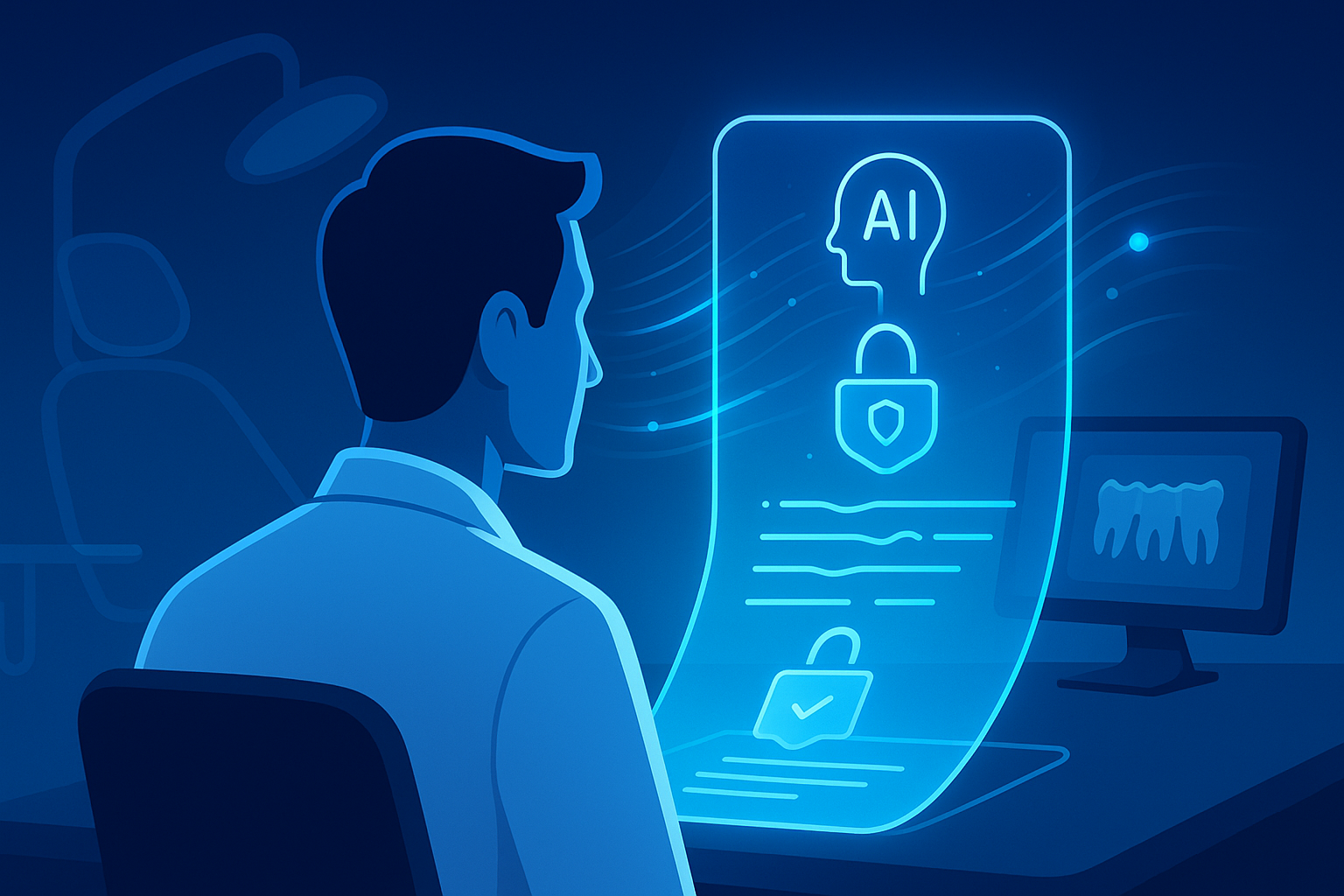
Alright, dental innovators, let's talk about a game-changer for your practice: Artificial Intelligence. Specifically, AI note-taking tools that promise to slash administrative time, boost accuracy, and free you up to focus on what truly matters - your patients. The potential to enhance efficiency and scale your operations is immense. But, as European dental practice owners, navigating the complex web of EU compliance, especially with sensitive patient data, can feel like walking a tightrope.
So, how do you harness the power of AI note-taking without stumbling into a regulatory minefield? Let's break down how to select a secure, compliant solution that genuinely drives ROI.
The AI Advantage: More Than Just Notes
Before we dive into the compliance maze, let's quickly recap why AI note-taking is worth considering. These tools aren't just fancy dictaphones. They can:
-
Slash Administrative Time: Imagine significantly reducing the hours spent on manual documentation. AI can automate transcription, summarize consultations, and even identify action items.
-
Boost Accuracy and Completeness: AI can capture intricate details from patient interactions, potentially minimizing errors and omissions common in manual notes. Some tools are even trained on specific dental terminology.
-
Enhance Consistency: Standardized, AI-driven summaries ensure uniformity in record-keeping across all practitioners in your clinic.
-
Improve Efficiency & ROI: Studies and practice experiences suggest productivity can increase by 20–35%, with specific automations yielding impressive returns.
Navigating the EU Compliance Gauntlet: GDPR & the EU AI Act
For European dental practices, compliance is non-negotiable. Patient data is sacred, and the penalties for mishandling it are severe. Here's what any AI note-taking solution must address:
General Data Protection Regulation (GDPR)
-
Data Processing Agreement (DPA): The vendor must provide a comprehensive DPA outlining their responsibilities.
-
Lawful Basis for Processing: You need a clear lawful basis, typically explicit patient consent, for processing sensitive health data.
-
Data Subject Rights (DSRs): The tool must help you respond to patient requests for access, rectification, or erasure of their data.
-
Data Residency & Transfers: EU/EEA data residency is strongly preferred. If data goes outside, legally sound transfer mechanisms (like SCCs with robust assessments) are critical.
-
Data Protection by Design & Default: The tool should be built with privacy as a core feature, minimizing data collection.
-
No Patient Data for General AI Model Training: This is a big one. Ensure the vendor explicitly states they won't use your patient data to train their general AI models. Opt-in for service improvement, with robust, irreversible anonymization, is the only acceptable path here.
-
Security: End-to-end encryption, strong access controls (like Role-Based Access Control and Multi-Factor Authentication), and clear data breach notification procedures are essential.
EU AI Act Considerations:
-
Risk Classification: AI systems handling health data are likely to be classified as "high-risk." This imposes significant obligations like conformity assessments, robust risk management, and quality management systems.
-
Transparency: Patients need to be aware if AI is involved in their care documentation. AI-generated summaries might need to be identified as such.
-
Human Oversight: Crucially, you and your team must be able to review, edit, and approve any AI-generated notes before they become official patient records.
-
Accuracy and Robustness: The AI's output must be consistently accurate and reliable.
Beyond Compliance: Essential Features for Dental Practices
Once you've shortlisted tools that meet the stringent EU compliance criteria, consider these dental-specific functionalities:
-
Dental Terminology Accuracy: The AI must understand and accurately transcribe specialized dental terms.
-
Quality Summarization: It should generate concise, clinically relevant summaries.
-
Action Item Identification: Can it reliably pick out tasks for your team (e.g., schedule follow-ups, lab requests)?
-
Ease of Use: The interface must be intuitive for all staff, regardless of their tech-savviness.
-
Integration Capabilities: How well does it play with your existing Practice Management Software (PMS)? Direct API integration is ideal, but many systems (like Exquise Next Generation, for example) may lack this. In such cases, look for easy export options (e.g., structured text, copy-paste compatibility, or Chrome extensions for web-based PMS).
A Look at the AI Note-Taking Landscape
The market offers a range of solutions, from general-purpose meeting assistants to tools specifically designed for healthcare and dentistry. Here's an overview:
Dental-Specific Champions:
-
Kiroku: Designed by dentists, for dentists. Kiroku emphasizes GDPR compliance, offers features like no audio storage (transcribes then deletes audio), and even an on-premise option for its clickable templates, which is excellent for data control. It's praised for understanding dental terminology and offers copy-paste or a Chrome extension for integration with PMS.
-
Heidi Health: A strong healthcare-focused AI scribe. Heidi Health states compliance with GDPR, HIPAA, and holds ISO 27001 certification. They emphasize UK/EU data hosting and provide an API, offering future flexibility if you change your PMS.
-
Dentascribe: This tool appears very similar to Kiroku and also mentions an on-premise option, which is a significant plus for GDPR-conscious practices.
Promising Generalists (Evaluate Carefully for Dental Use):
-
Fireflies.ai: A popular meeting assistant. Fireflies.ai states GDPR compliance, is SOC 2 Type 2 and HIPAA compliant, and importantly, asserts they do not use customer data to train their own AI models, with BAAs in place with their LLM vendors (like OpenAI) to enforce this. They offer an EU data storage option, but note that processing may still occur in the US, so scrutinize the DPA. Its extensive integrations (Zapier, API) are powerful but may be of limited direct use if your PMS lacks an API.
-
Jamie: Positions itself as a bot-free AI assistant that works online and offline, claiming GDPR compliance and EU data hosting (Frankfurt server). It supports custom vocabulary, which could be beneficial for dental terms.
-
Bliro: Often marketed for sales, Bliro offers bot-free transcription, customizable AI summaries, and is GDPR compliant. Its CRM integration focus might be less relevant for direct dental PMS integration without an API.
Powerful Platforms (Consider with Nuance):
- OpenAI ChatGPT Enterprise: The enterprise version of ChatGPT comes with strong data protection commitments, including not training on business data by default. Its "Record Mode" can transcribe and summarize meetings. However, the cost and complexity might be higher, and integrating it seamlessly into a dental workflow requires careful planning.
Tools to Approach with Extra Caution for EU Dental Use:
- Some general AI note-takers like Otter.ai have policies of using de-identified user data for model training, which is a significant concern for sensitive EU patient data. Others, like Read.ai and Granola, have had US data residency as a primary setup or past security/privacy concerns reported, making them potentially less ideal choices without very thorough vetting for a European dental practice.
Your Checklist for Choosing Wisely
Before committing to any solution, create a rigorous evaluation process:
-
Verify GDPR Compliance: Scrutinize the DPA. Confirm data residency and processing locations. Get explicit confirmation on their policy regarding the use of patient data for AI model training.
-
Assess EU AI Act Alignment: Discuss their roadmap for compliance, especially regarding human oversight, transparency, and risk management for health data.
-
Confirm Security Certifications: Look for ISO 27001, SOC 2 Type 2, or equivalent.
-
Test Dental Terminology Accuracy: Pilot the tool with your specific vocabulary.
-
Evaluate Integration & Workflow: How will it fit with your current PMS and daily operations? Is manual data entry feasible if direct integration isn't possible?
-
Pilot Program: Always run a pilot with a small group of users before a practice-wide rollout.
-
Patient Consent: Develop clear procedures for obtaining and documenting patient consent for AI-assisted note-taking.
Unlock Your Practice's Potential, Securely
Adopting AI note-taking can genuinely transform your dental practice, freeing up valuable time and resources to focus on patient care and business growth. However, for European dental business owners, this journey must be navigated with an unwavering commitment to security and EU compliance. By carefully evaluating solutions against stringent regulatory requirements and practical dental-specific needs, you can select a tool that not only enhances efficiency and ROI but also upholds the highest standards of patient data protection.
The landscape is evolving rapidly, but the principles of security, compliance, and patient trust remain constant. Making an informed choice now will set your practice on a path to leveraging AI's benefits responsibly and effectively.
Ready to explore how the right AI solutions can securely scale your dental practice and enhance your ROI? I'm Dr. Hernani Costa, an AI strategist focused on helping businesses like yours harness the power of artificial intelligence. Let's discuss your specific needs and chart a compliant path to AI-driven efficiency.
by Dr. Hernani Costa, First AI Movers
Author: Dr. Hernani Costa — Founder of First AI Movers and Core Ventures. AI Architect, Strategic Advisor, and Fractional CTO helping Top Worldwide Innovation Companies navigate AI Innovations. PhD in Computational Linguistics, 25+ years in technology.
Originally published at First AI Movers under CC BY 4.0.